Unlicensed Spectrum in Greece
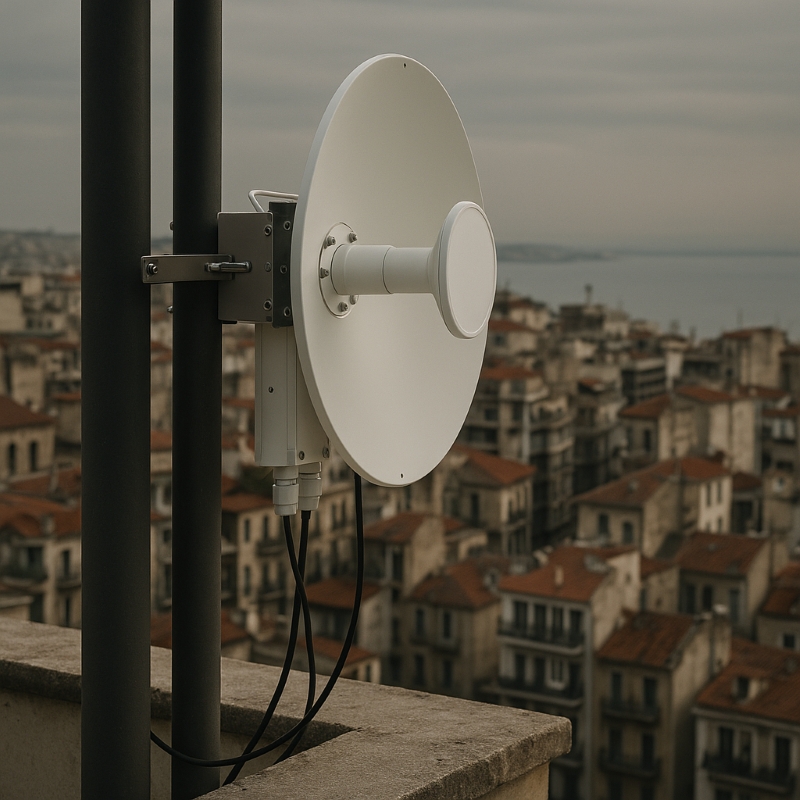
Wireless links (point-to-point or point-to-multipoint) are a critical component of modern telecommunications infrastructure, covering needs such as network backhaul, interconnection of remote sites, transport of data from security cameras, and industrial automation systems. Using licence-free frequency bands enables such links to be deployed without time-consuming licensing procedures, provided the limits set by EETT and the European ETSI/CEPT framework are observed.
However, not all licence-free bands are suitable for outdoor wireless links.
The 2.4 GHz band, although still technically open, is now overcrowded with Wi-Fi networks, IoT devices and other low-power applications, making it unsuitable for fixed links that require steady throughput and low latency.
Similarly, the 6 GHz band (5 945 – 6 425 MHz) has been designated by the European Commission, via Decision (EU) 2021/1067, exclusively for WAS/RLAN (Wi-Fi 6E/7) use. The Greek National Frequency Allocation Table (ΕΚΚΖΣ 2023) fully adopts this regulation, effectively prohibiting its use for fixed outdoor links. Only low-power devices are permitted (LPI up to 23 dBm EIRP indoors and VLP 14 dBm EIRP / 1 dBm/MHz outdoors) in order to protect satellite and microwave services already operating in the band.
Consequently, the truly available licence-free frequencies for outdoor wireless links in Greece are 5 GHz, 24 GHz and 60 GHz. These allow reliable and cost-effective links without a licence, as long as the technical limits for power and directivity are respected.
The sections below present, in detail, the permitted bands for outdoor use, the IEEE technologies that support them, their maximum speeds, and their practical constraints.
Licence-free frequencies for outdoor wireless links
Outdoor wireless links (PtP / PtMP) rely exclusively on the bands permitted by EETT for licence-free operation with defined emission limits (EIRP). These bands are 5 GHz, 24 GHz and 60 GHz, as specified by the National Frequency Allocation Table (Government Gazette Β’ 2628 / 21.04.2023) and the standards ETSI EN 301 893, EN 300 440 and EN 302 567.
5 GHz Band
Range: 5150 – 5875 MHz
Regulatory framework: ETSI EN 301 893 / ECC DEC(04)08 – UNII 1-4 bands
Maximum EIRP: 200 mW (20 dBm) to 1 W (30 dBm) depending on sub-band
IEEE technologies: 802.11 a/n/ac/ax (Wi-Fi 5 & 6) and proprietary PtP links (Cambium, etc.)
Technical characteristics & performance:
- Channel widths 20 – 160 MHz.
- Data rates up to 1–1.5 Gbps with MIMO 4×4 and 160 MHz bandwidth.
- Range up to 10–15 km in directional links with high-gain antennas (> 25 dBi).
Advantages:
- Ideal balance between range and speed.
- Wide equipment availability and mature technology.
- Outdoor use permitted with DFS & TPC (radar interference avoidance).
Limitations:
- Increased congestion in urban environments.
- Requires clear line of sight (LoS).
24 GHz Band
Range: 24.00 – 24.25 GHz
Regulatory framework: ETSI EN 300 440 / ECC REC(70-03) Annex 1
Maximum EIRP: 100 mW (20 dBm)
IEEE technologies: 802.11ad or proprietary millimetre-wave PtP solutions.
Technical characteristics & performance:
- Bandwidth 250 MHz.
- 1.5 – 2 Gbps in ideal conditions.
- Very low latency and high interference immunity due to narrow beam.
- Range up to 3 – 5 km in directional links with very high-gain antennas (> 30 dBi).
Advantages:
- Low risk of interference due to limited usage.
- Suitable for dense CCTV networks or local campus links.
Limitations:
- Shorter range and high rain attenuation.
- Limited spectrum width (only 250 MHz available).
60 GHz Band
Range: 57 – 66 GHz (licence-free in the EU)
Regulatory framework: ETSI EN 302 567 / ECC REC(09)01
Maximum EIRP: 40 dBm (10 W)
IEEE technologies: 802.11ad / ay – WiGig / mmWave PtP links.
Technical characteristics & performance:
- 9 GHz of available spectrum.
- Speeds up to 5 – 10 Gbps over very short distances 100 – 300 m.
- Very low latency (< 2 ms) and high spectrum re-use.
- Range up to 1 – 1.5 km in directional links with very high-gain antennas (> 38 dBi).
Advantages:
- Extremely high throughput for Gigabit backhaul.
- Near-zero interference due to strong oxygen absorption.
- Ideal for dense urban areas or Smart City networks.
Limitations:
- Short range and strong attenuation from rain or obstacles.
- Requires absolute line-of-sight and precise antenna alignment.
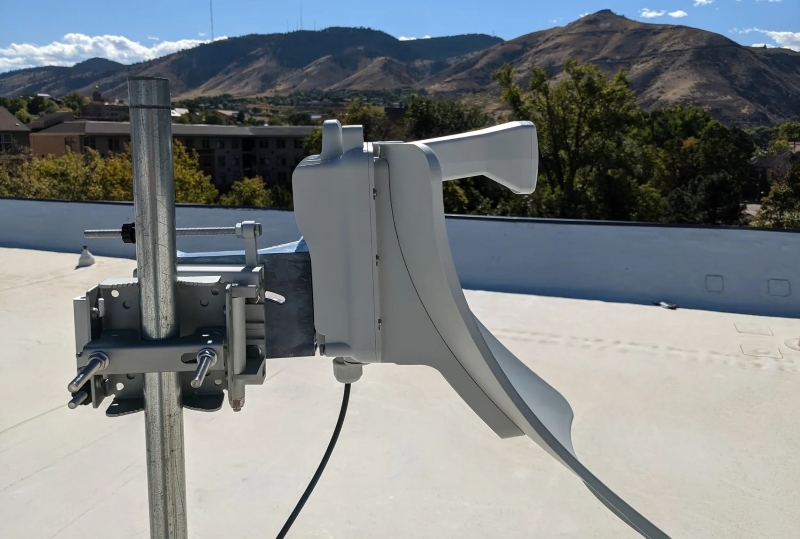
Licence-free frequencies are among the most useful tools for building wireless infrastructure, especially where wired interconnection is difficult or economically unviable. In Greece, the practically usable bands for outdoor wireless links are 5 GHz, 24 GHz and 60 GHz, which allow reliable point-to-point and point-to-multipoint connections without a licence, provided EETT emission limits are observed.
The 5 GHz band remains the foundation for many backhaul or CCTV applications, offering a combination of range and steady speed.
24 GHz fits industrial and dense urban environments with short/medium distances and a high concentration of links, while 60 GHz opens the way for gigabit backhaul and Smart City applications with extremely low latency.
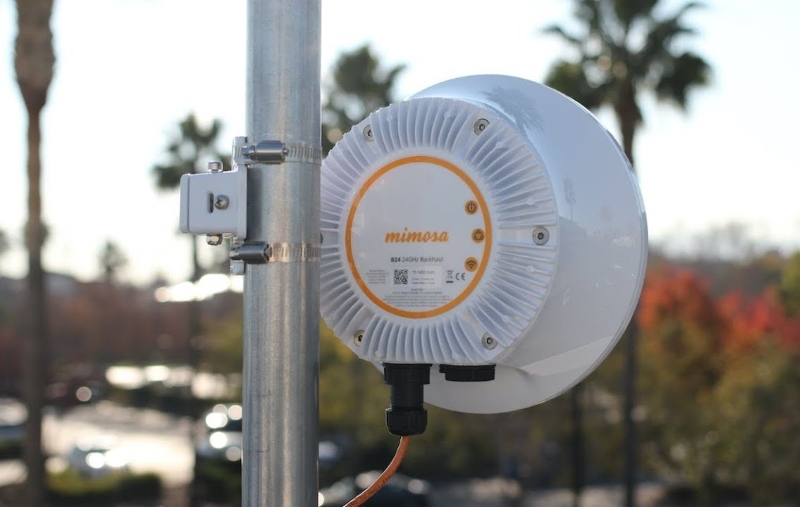
Layer 1 Technologies, a certified partner of Cambium Networks and Mimosa Networks, provides end-to-end services for the design and deployment of outdoor wireless networks. From equipment selection and link budgeting to installation, alignment, and ongoing technical support, the company ensures high availability, compliance with EETT standards, and maximum data-transport reliability.
Licence-free frequencies are a powerful tool for creating cost-effective and fast networks. With the right technology choice and the engineering precision of Layer 1 Technologies, every wireless link can achieve stable performance, full regulatory compliance, and resilience to real-world operating conditions.